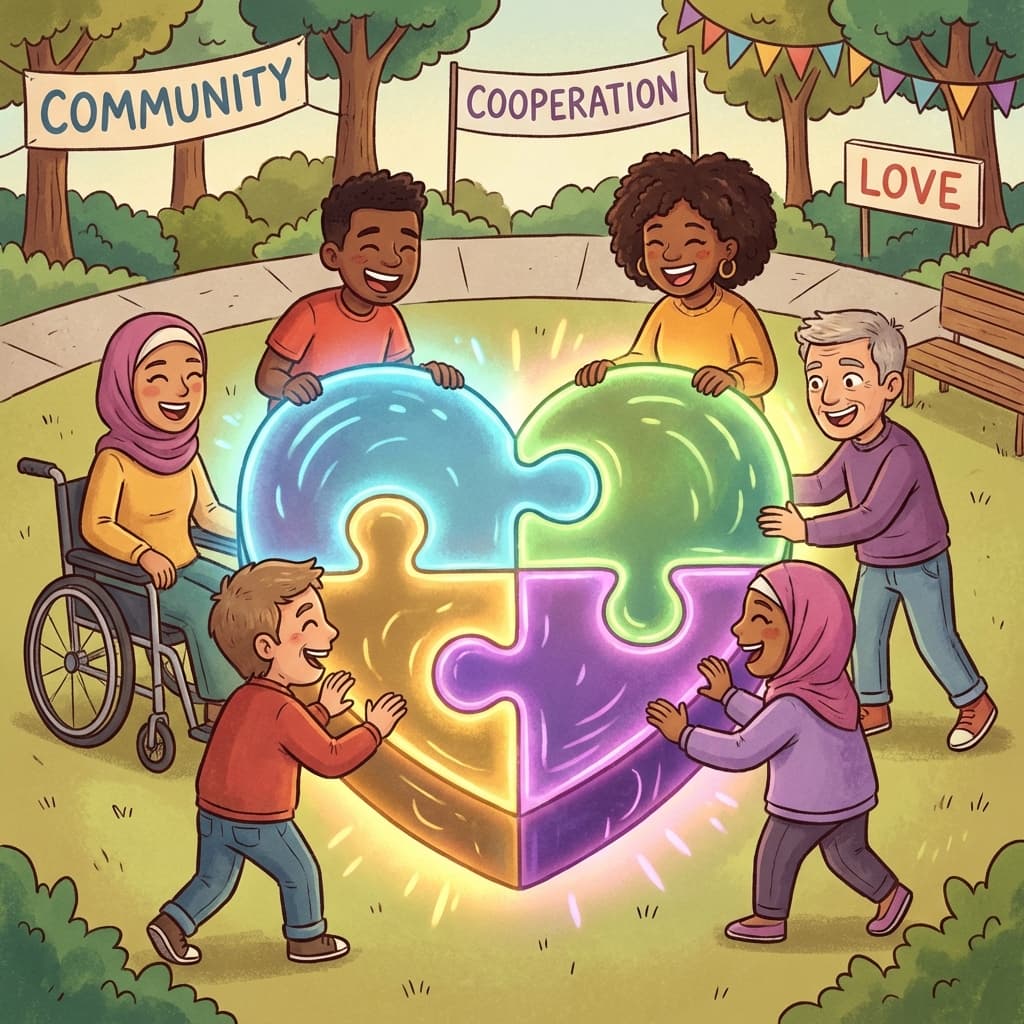
Together is Better: Unlocking the Superpower of Connection
Let's play a mental game. Imagine you have to lift a car.
You can go to the gym every day for ten years. You can drink protein shakes. You can get really, really strong. But no matter how strong you get, you probably can't lift a car over your head.
Now, imagine you have twenty friends. You don't need to be super strong. You just need to stand around the car, count to three, and lift together.
Up it goes!
This is the simple, undeniable math of the universe: We are stronger together.
In the world of technology and business, we often hear stories about the "Lone Genius." We see Iron Man building his suit all by himself in a cave. We see the coder in a hoodie hacking the mainframe alone in the dark.
But that is just Hollywood. It's a myth.
In the real world, the best things—the spaceships, the skyscrapers, the video games, the cures for diseases—are built by teams.
The Puzzle of Us
Think of a team like a giant jigsaw puzzle.
If everyone on the team was exactly the same—if everyone was a "blue corner piece"—you couldn't make a picture. You would just have a pile of blue cardboard.
To make a beautiful picture, you need different pieces. You need:
- Pieces that are good at math (The Engineers).
- Pieces that are good at colors and shapes (The Designers).
- Pieces that are good at talking and listening (The Leaders).
- Pieces that are good at finding mistakes (The Testers).
At Orb21, we celebrate our differences. We don't want everyone to think the same way. We want "Cognitive Diversity." That's a fancy way of saying: we want different brains!
When you have different brains working on a problem, you see solutions that a single brain would miss.
The Art of Listening
Being a good teammate isn't just about doing your job. It's about listening.
Have you ever played the game "Telephone"? Where you whisper a secret to one person, and they whisper it to the next? by the end, the message is completely different!
That happens in work, too. That's why listening is a superpower.
True listening means:
- Stopping your own thoughts. Don't just wait for your turn to speak. Really focus on what the other person is saying.
- Asking questions. "What do you mean by that?" "Can you explain that again?"
- Being kind. Even if you disagree, you can say it nicely. "That's a cool idea, but have you thought about this?"
Kindness is Competitive Advantage
Some people think that to be successful, you have to be mean. You have to be a shark. You have to eat the little fish.
I think those people are wrong.
In the long run, kindness wins.
Think about it. Who do you want to work with?
- Person A: Super smart, but yells at everyone and never shares credit.
- Person B: Pretty smart, but always helps you, says "Great job," and brings donuts.
You want to work with Person B! Everyone wants to work with Person B.
Person B builds a great team. Person A ends up alone.
At Orb21, we have a rule: "No jerks allowed." We believe that a happy team writes better code. When you feel safe, you are more creative. You aren't afraid to try new ideas.
The Multiplier Effect
Here is the magic math of teamwork:
If you work alone, 1 + 1 = 2. If you work together, 1 + 1 = 100.
When we bounce ideas off each other, they get better. My small idea might spark a big idea in your head. Your drawing might inspire my story.
We amplify each other.
Build Your Team
You don't need a company to have a team. Look around you.
- Your family is a team.
- Your class is a team.
- Your friends are a team.
Start practicing your teamwork skills today. Help someone with their homework. Share your toys. Listen to someone's story. Say "Thank you."
Because the biggest problems of the future—like climate change, or exploring Mars—are too big for one person. We are going to need a whole planet of teammates to solve them.
So let's hold hands and lift the car together.